Showing posts with label ethics. Show all posts

Sep 20, 2011

Listen Up

"Life isn't about [making money].  It shouldn't be about that."
In case you missed it last Friday, Justin was featured during a segment on KWMU's "Cityscape" program.  Collaborating with Sauce Magazine, Cityscape aired a story on urban farming in St. Louis. Producers caught up with Justin to get his take on what caused him to become passionate about urban farming as a way of life.  

If you missed the segment, listen to it here:
http://kwmuweb.streamguys.com/Cityscape/091611bweb_small.mp3  Justin's part begins around the 03:37 minute mark.

Sep 16, 2011

Back to the Start

For those of you not familiar with this video yet, several weeks ago the popular food chain Chipotle uploaded a video of Willie Nelson covering Coldplay's "The Scientist," with computer animation accompanying the song.


Don't view it as just a commercial for Chipotle, however.  The company commissioned the video to emphasize the importance of developing a sustainable food system, and I think it hits its target spot-on.  Willie's cover of the song is haunting, as is the narrative of the cartoon, and yeah, I'll admit that it made my eyes well up a little.

As long-time supporter's of Farm Aid (Willie Nelson's other project), we're happy to see Willie Nelson supporting Chipotle's endeavor to highlight the importance of sustainable agriculture.

May 17, 2011

It's That (Itchy) Time of Year Again...

Spring has sprung, and our crops are growing, and as such our back door is seeing tons of activity as Justin and I travel from inside to outside, and vice versa, with gardening tools, plants, and other items.  However, we're not the only two coming in and out of the house; mosquitoes are, too.  Last night, for instance, I managed to swat a half dozen blood suckers.  Although, swatting with my hand is as far as I'll go to kill these pests.

As residents of St. Louis County, our local government routinely sprays for mosquitoes from the months of May through October.  However, the mosquito tucks don't spray down our block.  That's because we're on the do-not-spray list.  Yes, it's true, people have a right to opt-out of mosquito spraying!

But what's the problem with mosquito spraying, you ask?  Plenty.

Sep 20, 2010

The Future of "Food"?

Genetically engineered animals are inching dangerously closer to our dinner plates today, as the FDA commences public hearings on whether to approve gene-altered salmon for human consumption.

AquAdvantage® Salmon (AAS) is the creation of Massachusetts-based AquaBounty Technologies. The company boasts that AAS "reach market size twice as fast as traditional salmon," thereby creating a more economical and efficient meat source for producers.

...and thereby making it logistically easier for fish farms to turn into CAFOs: growing more fish in faster time with less space.

One ethical problem with AquaBounty's engineering of salmon is that they approach the fish as merely a product or commodity, with the end-goal being increased revenue for both AquaBounty and the fish producers who buy their product.

As we mentioned previously about Cornish cross chickens, animals bred for size exhibit signs of pain and muscle immobility. Considering that Cornish crosses cannot move a few paces without their legs tiring from carrying their own weight, we wonder whether AquaBounty's product will suffer any health implications from being genetically altered for size.

Sure, gene-altered salmon seem like a great idea for AquaBounty shareholders... but is it a good idea for the fish themselves?

If you share our concern over this technological innovation, Food & Water Watch provides an excellent online petition for you to voice your doubts to lawmakers. Click here, and also note that they provide phone and fax numbers for the White House, should you really want to get your point across.

Sep 4, 2010

Chicken Spotlight: Naked Neck

The recent recall of salmonella-tainted eggs has highlighted once again the problems with industrial animal production: Inhumane treatment + unclean facilities + questionable practices = diminished food security. So we figured now's a good time to fill you in on our latest venture: raising naked neck chickens.

Naked necks, also called "turkens," can be found in pockets across the globe. Rather than a breed, the "naked neck" is a gene wherein the chickens lack feathers on their neck and have significantly reduced feathers over the remainder of their body.

And what are feathers made of? Mainly protein. Because naked necks have fewer feathers, their diet doesn't require as much protein as other chicken breeds - instead, naked necks convert excess protein into eggs and meat more efficiently than other breeds!

Keep in mind that today the main breed being supplied is the cornish cross. Regardless of whether you're buying conventional or even "free range," chances are you're purchasing a cornish cross chicken. The problem with this breed is that its specifically bred for industrial production. Cornish crosses build muscle mass at such a fast pace that they cannot move more than a few feet without getting tired (hardly "free range"), and they reach market weight in a monstrous 49 days.

However our naked necks are quite the opposite. While naked necks are efficient in protein conversion, they happen to be a comparatively slow grower - reaching market weight in 10-12 weeks. But the meat it does grow is darker, richer, the skin more delicate, and the fat more yellow in color than conventional chickens. It's one of several, lesser-used chicken breeds that supply richer meat, yellower skin, and more flavorsome fat than typical breeds, and it happens to pair well with our climate and growing conditions.

We hope to have a modest flock by the beginning of October and will be sure to keep you posted on our progress.
Aug 23, 2010

What We're Reading Right Now

"The very meaning of food is being transformed: food cultures that once treated cooking and eating as central elements in maintaining social structure and tradition are slowly bring usurped by a global food culture, where cost and convenience are dominant, the social meal is obsolete, and the art of cooking is fetishized in coffee-table cookbooks and on television shows."

"We eat every day. We put our forks into something or someone three times a day. We cannot disengage ourselves, even if we wanted to. We are all involved in agriculture on a daily basis. We vote with every meal. We make a difference with every bite. We cannot choose to ignore this issue, thinking it has nothing to do with us. It has everything to do with us."

A Month's Worth of Lunch

Want to go a little further in your fight to help the environment? We all eat, but have you ever taken into account the massive amounts of packaging tied to the food we consume? Being more conscious about how to reduce food waste is one of the easiest ways we can make a difference environmentally.

Danielle works a typical 9-5, and she used to spend upwards of $50 per week on lunches from nearby grocery stores and restaurants - lunches wrapped in plastic or styrofoam, with plastic silverware, in plastic or paper bags. However, she stopped all that ridiculousness in 2007, and she's been bringing her own lunches to work ever since: homemade soups, leftover rabbit stews, pastas, sandwiches, tomatoes, squash and other vegetables from our garden - all on reusable china or in compostable wrappings. The picture here is what July's lunches looked like for Danielle.

The folks at TakeOutWithOut have launched a campaign to reduce restaurant waste. Check it out and become inspired to readjust your own eating habits. You can make a difference too, one lunch at a time.

Aug 6, 2010

What We're Reading Right Now

"Nature did not intend for animals to live by the hundreds or thousands, crammed together inside buildings, raised with pharmaceutical products, with no access to grass, sunlight, or the clean, healthy scent of outdoor air."

"Many Americans have no idea where their food comes from, and many have no desire to find out."

May 27, 2010

Not Certified? Not Bad!

While providing 10 tips for shopping at farmers markets, the folks over at Serious Eats make an excellent point about why small-scale farmers may not be certified organic:
"The fact that produce is not labeled organic doesn't necessarily mean it's swimming in pesticides or is a qualified member of the Dirty Dozen. Sometimes it's quite the opposite. Some of the best farms, where a single farmer can lovingly attend to every seedling, are hardly bigger than a postage stamp. A farm that size can't afford a refrigerated truck, never mind a costly (and questionably bullet-proof) certification by the USDA. Many farms use organic practices, often much more stringent than those required by the government, but simply don't get certified."
That pretty much explains why we're not certified organic here at YellowTree Farm - but please rest assured that we use organic practices and we never, ever use pesticides.

May 5, 2010

No Spray Zone

With mosquito season upon us, you should know you have a right to opt-OUT of pesticide fogging. St. Louis, Missouri sprays May-October. Residents can call (314)727-3097 and ask to be put on the Do Not Spray list. You can also call (314)615-4BUG to find out nightly spraying routes in St. Louis County. We strongly encourage folks who live in other parts of the country to research who to contact in your local area to find out how to opt-out of mosquito spraying.

After all, it defeats the purpose of having an organic garden if the county's going to pump known carcinogens into the air every couple weeks.

Apr 19, 2010

Set Your DVRs

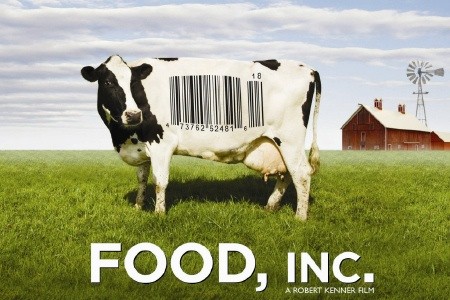
This week (Wednesday, April 21), PBS will be airing the acclaimed documentary, Food Inc. If you haven't seen it yet, you should. If you've already seen it, you could probably benefit from watching it again. It's a crucial movie for anyone who eats - and, well, that includes everyone. Consider this YellowTree Farm's official endorsement.

Mar 12, 2010

Pesticide Free Zone

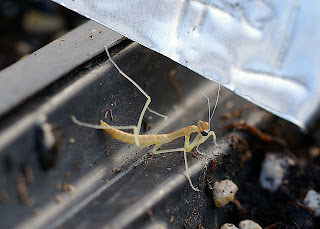
We don't use pesticides at YellowTree Farm, we use bugs. These mantises were hatched recently in our greenhouse, and we keep dormant ladybugs on hand to assist when needed.

Nov 25, 2009

Quote of the Day

From celebrity chef Eric Ripert, on his outing to Costco...

"I am freaked out. Costco depresses me. I know everybody doesn't have the same opportunities I do to visit farm stands and little markets, but I will fight to the end for inspirational shopping. Costco doesn't even look like it belongs on our planet. It could be on the moon. It has no relationship to the outside world as I know it. The lighting, the temperature, the outrageous abundance. The store has no life and no contact with anything that comes from the earth. Everything is packaged, sterile, clinical. Nothing about the food is emotional. And there is a wicked genius at work, mixing the organic with the terribly processed."


The Making of an Industrial Turkey

The folks over at The Business Insider compiled a little slideshow providing a glimpse into the world of the typical Thanksgiving turkey. Take a look, and this year be thankful for what it took to get that bird onto your plate.

Oct 10, 2009

Our Daily Bread...

Our Daily Bread (2005) reveals the little-known world of high-tech agriculture. In a series of visually stunning, continuously tracking, wide-screen images that seem right out of a science-fiction movie, we see the places where food is cultivated and processed: surreal landscapes optimized for agricultural machinery, clean rooms in cool industrial buildings designed for maximum efficiency, and elaborate machines that operate on a 'disassembly line' basis. The documentary simply aims to show the industrial production of food as a reflection of our society's values: plenty of everything, made as quickly and as efficiently as modern technology permits.

Sep 22, 2009

What we read this summer

With summer officially at a close, these were three books that kept our minds turning all season long...